
Handy Links
SLAC News Center
SLAC Today
- Subscribe
- Archives: Feb 2006-May 20, 2011
- Archives: May 23, 2011 and later
- Submit Feedback or Story Ideas
- About SLAC Today
SLAC News
Lab News
- Interactions
- Lightsources.org
- ILC NewsLine
- Int'l Science Grid This Week
- Fermilab Today
- Berkeley Lab News
- @brookhaven TODAY
- DOE Pulse
- CERN Courier
- DESY inForm
- US / LHC
SLAC Links
- Emergency
- Safety
- Policy Repository
- Site Entry Form

- Site Maps
- M & O Review
- Computing Status & Calendar
- SLAC Colloquium
- SLACspeak
- SLACspace
- SLAC Logo
- Café Menu
- Flea Market
- Web E-mail
- Marguerite Shuttle
- Discount Commuter Passes
-
Award Reporting Form
- SPIRES
- SciDoc
- Activity Groups
- Library
Stanford
Around the Bay
Hey, WIMPs: Beware of Dwarf
 Stars may be bullies in their old age. White dwarfs—dense, collapsed stars in their final stage of life—could be skilled at swallowing and annihilating weakly interacting massive particles (WIMPs). These particles may
constitute a large portion of the dark matter in the universe, and could form extremely dense
concentrations near supermassive black holes. Physicists Igor Moskalenko and Lawrence Wai plan to
glean GLAST data to learn whether these concentrations of dark matter exist. If they do, WIMP-swallowing
stars could reveal the secrets of black holes. Their paper will be published in the April 10 issue of
Astrophysical Journal Letters.
Stars may be bullies in their old age. White dwarfs—dense, collapsed stars in their final stage of life—could be skilled at swallowing and annihilating weakly interacting massive particles (WIMPs). These particles may
constitute a large portion of the dark matter in the universe, and could form extremely dense
concentrations near supermassive black holes. Physicists Igor Moskalenko and Lawrence Wai plan to
glean GLAST data to learn whether these concentrations of dark matter exist. If they do, WIMP-swallowing
stars could reveal the secrets of black holes. Their paper will be published in the April 10 issue of
Astrophysical Journal Letters.
"This research could reveal a completely new kind of star, and could provide insight into how supermassive black holes evolve," Wai said. "We're very excited about this possibility."
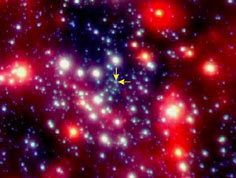
A few bright stars are known to orbit very close to the supermassive black hole at our galaxy's center. WIMPs may concentrate near this black hole, where white dwarfs sweeping close by could efficiently capture and "burn," or annihilate, many of them. Moskalenko and Wai propose that using GLAST to find dark matter near the supermassive black hole could implicate stars seen orbiting nearby as thriving WIMP eaters.
Their hypothesis will soon be tested when GLAST collects gamma-ray data and scientists search for dark-matter annihilations near our galaxy's supermassive black hole. If it were to be found, a spike in dark matter concentration near the black hole would betray much about the nature of our universe.
"The observation of stars orbiting close to the supermassive black hole at the center of our galaxy was a huge discovery," Wai said. "If some of those stars are WIMP burners, they could provide unique information on dark matter structure."
—Alison Drain, March 29, 2007
Above image: Arrows in the center of this image point toward the supermassive black hole at the galactic center of the Milky Way galaxy. GLAST data may soon provide evidence of WIMP-burning stars nearby. (Image courtesy of the European Southern Observatory.)